Thursday, 30 April 2009

1996 Cease-fire breaks down

IRA Ceasefire: This is not peace; it is simply the prelude to a different war: Conor Cruise O'Brien warns that the IRA's struggle for a united Ireland will continue - and the bombs and bullets could return


The image “http://www.troopsoutmovement.com/Belfast10thSept05-002.JPG” cannot be displayed, because it contains errors.

this was the headline for the IRA ceasefire break down and this what they said.

THE IRA has announced 'a complete cessation of military operations'. This is a lot less than 'the permanent cessation of violence' which the Dublin and London governments have asked for, although Dublin is busy trying to blur the distinction. The indications are that the ceasefire will not be prolonged. Gerry Adams has stipulated that it must be accompanied by what he calls 'rapid progress on constitutional and other issues'. John Major is unlikely to supply 'progress' on a scale and in a manner satisfactory to the IRA. Once that is fully apparent, the IRA will break off the ceasefire, putting the blame for ensuing violence on British bad faith.
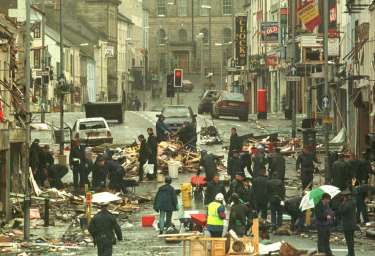
The image “http://cain.ulst.ac.uk/events/omagh/omagh.jpg” cannot be displayed, because it contains errors.

For the IRA, the new ceasefire is a promising tactical innovation, within a strategy that remains altogether unchanged. The immediate objective remains the destabilisation of Northern Ireland, with a view to its elimination as a political entity and its incorporation in a Catholic-dominated united Ireland.

The image “http://www.abc.net.au/reslib/200507/r54017_146143.jpg” cannot be displayed, because it contains errors.

The 'armed struggle' of the IRA over the past quarter of a century has seen considerable progress towards this goal. The 'unarmed struggle' (aka 'unarmed strategy') will dominate the period of the ceasefire, and is intended to speed up the destabilisation. According to Tuesday's Irish Times: 'The elements of this are expected to include street protests, civil disobedience, agitation over the closure of Border roads and community self- help against loyalist attacks'. Those who expect the ceasefire to usher in a new era of peace and harmony in Northern Ireland are in for a rude awakening.

The image “http://loyalengland.homestead.com/files/mural_rhc2.jpeg” cannot be displayed, because it contains errors.


IRA cease fire 1994

In 1994 the IRA realsised that they were going to ceasefire after hundreds of years of Irish fight the British Army and Laws they had put in place. Whenever they realised that they were going on a ceasefire all the reporters cushed into get their story after reporting the fighting between the two countries. This is a report from the British reporters of BBC.


Eve of IRA ceasefire 1994 (image by Crispin  Rodwell)
1994: IRA declares 'complete' ceasefire
The IRA has announced a ceasefire after a quarter of a century of what it called its "armed struggle" to get the British out of Northern Ireland.

The image “http://newsimg.bbc.co.uk/media/images/39978000/jpg/_39978168_sinnfein1994ceasefire203.jpg” cannot be displayed, because it contains errors.

The statement came just after 1100 BST and said there would be a "complete cessation of military operations" from midnight tonight and that the terrorist organisation was willing to enter into inclusive talks on the political future of the Province.

The image “http://newsimg.bbc.co.uk/media/images/40441000/jpg/_40441437_iramore-203.jpg” cannot be displayed, because it contains errors.

The statement has raised hopes for peace and an end to 25 years of bombing and shooting that has led to the deaths of more than 3,000 people.

The image “http://upload.wikimedia.org/wikipedia/en/thumb/b/b0/IRA_Resistance_Poster.jpg/250px-IRA_Resistance_Poster.jpg” cannot be displayed, because it contains errors.

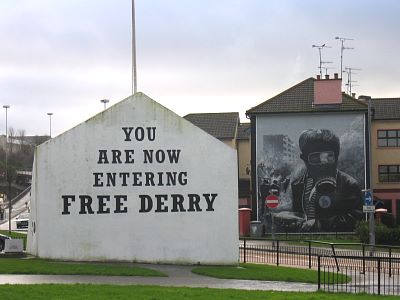
There is scepticism from the loyalist community and celebration in the Catholic areas of Belfast and Derry.

The image “http://www.designersnotebook.com/News/images/Free_Derry.jpg” cannot be displayed, because it contains errors.


Thursday, 23 April 2009

Northern Campaign is a term used to describe attacks involving volunteers of the Irish Republican Army (IRA) during the Second World War between September 1942 and December 1944. It was a plan conceived by the then IRA Northern Command to launch attacks within Northern Ireland during this period. The plan, however, did not translate into tangible or co-ordinated action on the part of IRA units during the time frame. The title "Campaign" can largely be interpreted as having meaning only to the IRA Army Council of the period and later generations of IRA volunteers and Irish republicans wishing to canonise IRA activity of the period.

The image “http://newsimg.bbc.co.uk/media/images/40842000/jpg/_40842290_ira_mural_north_203.jpg” cannot be displayed, because it contains errors.
The Northern Campaign 1942–1944 should not be confused with the Border Campaign of the 1950s or the Provisional IRA campaign 1969-1997 which is also referred to as the "Northern Campaign" in some Republican circles and histories of the IRA / PIRA.

The image “http://files.splinder.com/233f95fca348a8f74be0a93cfa001ee4.jpeg” cannot be displayed, because it contains errors.


The First Home Rule Bill (official name: Irish Government Bill, 1886) was the first major attempt made by a British parliament to enact a law creating home rule for part of the United Kingdom of Great Britain and Ireland. It was introduced on 8 April 1886 by Liberal Prime Minister William Gladstone to create a devolved assembly for Ireland which would govern Ireland in specified areas. The Irish Parliamentary Party under Charles Stewart Parnell had been campaigning for home rule for Ireland since the 1870s.


The Bill, like his Irish Land Act 1870, was very much the work of Gladstone, who excluded both the Irish MPs and his own ministers from participation in the drafting. Following the Purchase of Land (Ireland) Act 1885 it was to be introduced alongside a new Land Purchase Bill to reform tenant rights, but the latter was abandoned.


The First Home Rule Bill (official name: Irish Government Bill, 1886) was the first major attempt made by a British parliament to enact a law creating home rule for part of the United Kingdom of Great Britain and Ireland. It was introduced on 8 April 1886 by Liberal Prime Minister William Gladstone to create a devolved assembly for Ireland which would govern Ireland in specified areas. The Irish Parliamentary Party under Charles Stewart Parnell had been campaigning for home rule for Ireland since the 1870s.


The Bill, like his Irish Land Act 1870, was very much the work of Gladstone, who excluded both the Irish MPs and his own ministers from participation in the drafting. Following the Purchase of Land (Ireland) Act 1885 it was to be introduced alongside a new Land Purchase Bill to reform tenant rights, but the latter was abandoned.
The Armada had attempted to return home through the North Atlantic, when it was driven from its course by violent storms and toward the west coast of Ireland. The prospect of a Spanish landing alarmed the Dublin government of Queen Elizabeth I, and harsh measures
were prescribed for both the Spanish invaders and any Irish who might assist them.

The image “http://wpcontent.answers.com/wikipedia/commons/0/0f/Routes_of_the_Spanish_Armada.gif” cannot be displayed, because it contains errors.

In the event, up to 24 Spanish ships were wrecked on a rocky coastline spanning 500 km, from Antrim in the north to Kerry in the south, and the threat to Crown authority was readily defeated. Most of the survivors of the multiple wrecks were put to death, and the remainder fled across the sea to Scotland. It is estimated that 5,000 members of the fleet perished in Ireland.

The image “http://www.historic-uk.com/CultureUK/SpanishArmadaWK-PubDom.jpg” cannot be displayed, because it contains errors.